What happens if we gobblefunk around with words?
harms, hubris and honesty
If I was in charge of universities I would make Roald Dahl’s 1982 story, “The BFG”1 compulsory reading for all healthcare professionals.
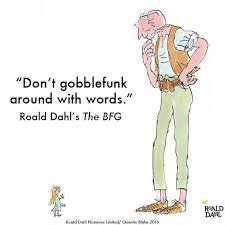
“Gobblethunk”, the word play and puns language spoken by the BFG, was inspired by Patricia Neal’s post-stroke speech disorder. The Oscar winning actress, and Dahl’s wife, had parietal lobe damage and associated word finding difficulties, using nonsense words like swatchscollop for food she did not like. The BFG is a marvellous lesson in communication barriers for those of us needing reminded of the basics in providing good care.
Last year Puffin required Dahl’s back catalogue to “be nice”. Dahl has a reputation of being racist, anti-Semitic and just plain mean, so his publisher set about tidying up his work in order to protect the feelings of anyone who might read it. The word “fat” was removed from every book.
There was an outcry, Salman Rushdie (a man who understands censorship more than most) said the edits were “absurd”, Rishi Sunak commented and Puffin half-reverse-ferreted by doubling it’s costs and printing both original and “updated” versions of Dahl’s work - something which Dahl, on account of being dead, could not consent to.
Retrospective censoring without consent of writers is a worrying development. The Oxford Roald Dahl Dictionary says “If you gobblefunk with words, you play around with them and invent new words or meanings.” and I’d add to the BFG’s sage advice:
“don’t gobblethunk around with words”…especially if the words are not yours.
I assume my governing body disagrees as they have gifted themselves rights to remove or edit the words of members if those words are deemed to be transphobic.
The Chartered Society of Physiotherapy, which is both trade union and governing body for 65,000 members, has been hyper-focussed on the needs of people with a gender difference in recent times. This is fine, people with gender issues deserve excellence in healthcare, but many physios have become increasingly concerned that those we pay to represent us repeatedly condemn us as transphobic - without supplying any evidence at all.
The day after the Cass Review they released this position statement on transphobia. I am not a lawyer but I think the legal term for a statement like this from a professional body is “a hot mess”.
I’d like to discuss it with them but I can’t see how to do so without breaching their position on transphobia. As Reduxx reported, the Chartered Society of Physiotherapy says:
“CSP commits to “preventing our channels being used to spread transphobia. We do not monitor posts in real time but will remove or edit comments which do not conform to the position statement as soon as we can.”
Accordingly, our governing body has removed words of members from our online in-house forum that they deem to be transphobic. Our new position statement seems to mean that healthcare professionals discussing sex as a material reality and something that sometimes matters in life and law is hateful.
I live in Scotland where the Hate Crime and Public Order (Scotland) Act came into force on 1 April. It aims to tackle harm caused by prejudice and abusive behaviour based on age, disability, religion, sexual orientation or transgender identity. It has been in place for less than a month and has already been used to arrest a 74 year old woman who was accused by a neighbour of using ableist language. A conviction carries a penalty of seven years and my governing body links to the assorted bits of criminal law which would apply to transphobic abuse.
What does this all mean? Are 65,000 members of a trade union actually discriminatory? I’ve not seen anything reported in the press or heard of any disciplinary processes about transphobic physiotherapists. I don’t believe I know any, and as I have been repeatedly accused of transphobia myself by professional peers, I suspect that for some people, discussing sex is, in and of itself, denying someone’s gender and therefore considered transphobic.
I think that language matters, specifically that the meaning of words, clarity of communication and freedom of speech.
If you want to provide health information for a population you need to be clear in your communication. Words matter - and obfuscating the meaning of your message by writing “person” when you mean “woman” prevents you from achieving your aims and does objective harm. This is understood and evidenced by many, not least by Gribble et al in 2002.
My field is women’s health - female health. Some think excluding trans women from these services is exclusionary and transphobic which I cannot understand because, obviously, not all trans people are male.
Women’s health is sexed health. Style, sexual orientation, sexuality, gender, sense of self, fury and identity don’t impact on physiology.
It wouldn’t have mattered how much Patricia Neal desperately wanted to change her situation would have been able to undo her stroke that left her in a coma for three weeks during her pregnancy, and that instead of a lovely baby moon she had to learn how to care for an infant without the ability to walk or string a sentence together - no amount of wishing could change her situation.
What did change her situation was intense rehab, which was dramatised2 and beautifully shows the importance of clarity and communication for people with health needs.
An approach of:
“What I mean and what I say is two different things,"
might be acceptable for a BFG but it’s absolutely not acceptable for healthcare professionals.


Fantastic read.